Originally published by Elisha Newell of Business News
25.02.2026
For many years, the list of Western Australia’s largest private businesses by revenue has read like a Pilbara balance sheet.
Mining behemoths including Hancock Prospecting, Roy Hill and Atlas Iron have long dominated Business News’s annual rankings (full list, page 33), with major contractors Byrnecut and Georgiou close behind.
Ahead of its inaugural Top 100 Private Businesses publication, Business News broadened its scope this year to look at not just private companies, but the co-operatives and not-for-profits that have become financial powerhouses.
Familiar names still fill the upper reaches of the list. Iron ore remains the single biggest source of private wealth in the state, and mining services companies continue to set the bar on both revenue and profit.
But a closer look at the top 20 private businesses tells a more nuanced story.
While mining still anchors the rankings, WA’s private businesses are slowly becoming denser, more competitive and more structurally diverse. In turn, this is reshaping what scale looks like in WA’s private economy.
Even amid this subtle reshaping, Hancock Prospecting’s spot at the top of the table remains unchallenged.
Gina Rinehart’s iron ore powerhouse again leads the state by revenue, assets and profit in 2026, despite a pullback from recent peaks.
Hancock’s consolidated revenue fell to $11.6 billion in FY25, down from $14.7 billion a year earlier, while its net profit after tax dropped 44 per cent to $3.1 billion.
The retreat reflects softer iron ore prices and lower dividend flows from Roy Hill and Atlas Iron, rather than a loss of operational heft.
Hancock’s earnings remain anchored by its 70 per cent stake in Roy Hill, its 50 per cent interest in Hope Downs, and its wholly owned Atlas Iron business.
Its balance sheet grew 8 per cent to $43.9 billion in assets in FY25.
Even in a weaker year, Hancock’s profit dwarfs every other private business in the state.
But in its latest reporting, the company said it was bracing for rising headwinds in iron ore, including growing regulatory costs and competition from rival jurisdictions.
The group singled out Rio Tinto’s Simandou project in Guinea as a longer-term threat, noting it would compete directly with Australian exports.
Chief executive Garry Korte said Australian producers were navigating rising expenditure and regulatory complexity, warning that higher costs risked pricing local exporters out of the market.
Despite the softer result, Hancock remained Australia’s largest private corporate taxpayer, paying $2.6 billion in state and federal taxes broadly in line with its profit result.
Roy Hill alone delivered $1.8 billion in profit, while Hope Downs contributed $832 million and Atlas Iron posted a $260 million result after shipping 10 million tonnes of ore.
Atlas’s profit was down 40 per cent year-on-year, reflecting an 18 per cent fall in realised iron ore prices, but the business pressed ahead with construction of its $600 million McPhee Creek mine and continued early works to de-risk its longer-dated Ridley magnetite project.
Beyond iron ore, Hancock has accelerated its push into critical minerals, committing $125 million to lift its stake in Arafura Rare Earths to 15.7 per cent as part of a broader portfolio estimated to exceed $3.5 billion in value.
It also advanced its Perth Basin gas ambitions, lodging plans for an $850 million Belisama gas processing facility following its $1.1 billion acquisition of Mineral Resources’ Lockyer and North Erregulla assets.
Internationally, Hancock moved to secure a joint venture with Saudi Arabian state-backed miner Maaden to explore for gold and copper under the kingdom’s Vision 2030 strategy. It is the first Australian company to do so.
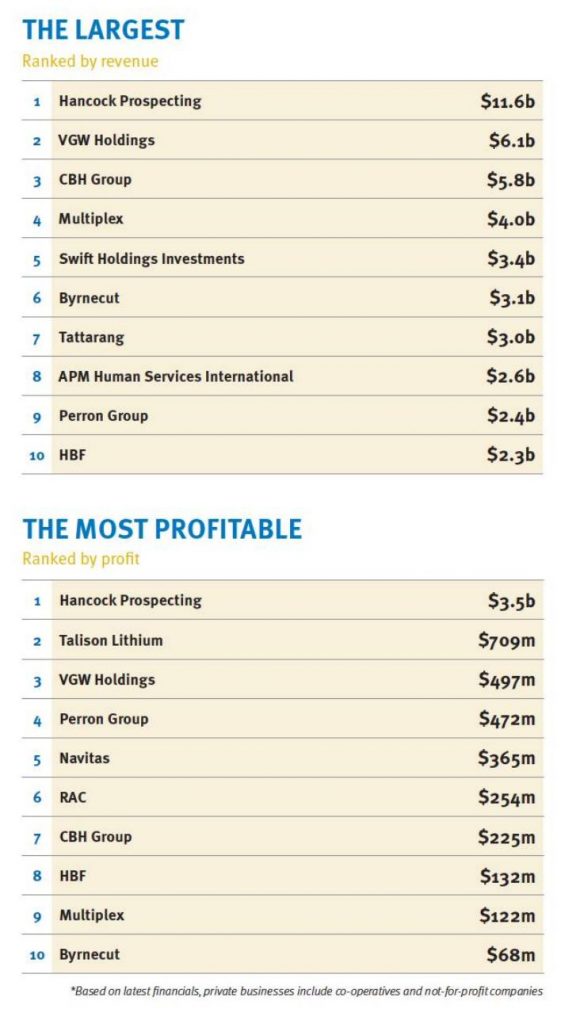
Outside the Hancock group, only a handful of private businesses generate profits measured in the hundreds of millions.
The standout remains VGW Holdings, the online gaming company that remains a staunch outlier in the traditional mining state.
In FY24, VGW delivered $6.1 billion in revenue and almost $500 million in profit, driven largely by its US customer base and the scale of its digital gaming platforms.
In 2025, founder Laurence Escalante moved to buy out the company’s minority shareholders in a deal that valued VGW’s equity at about $3.2 billion, offering $5.05 per share for roughly 190 million shares held by about 1,000 investors.
That transaction, approved by shareholders, was framed as a long-awaited liquidity event after VGW opted not to pursue an IPO, but it also arrived against a backdrop of softening trading conditions and rising regulatory scrutiny in the US.
VGW is now firmly entrenched as the state’s most profitable non-resources private company, but its success also highlights the limits of WA’s diversification.
Fifteen years after its founding, the tech company remains an exception rather than the rule, with few Perth unicorns managing to replicate VGW’s scale, margins or global reach while remaining private.
Trailing not too far behind, but in another league entirely, grower-owned CBH Group remains one of WA’s most consequential enterprises thanks to its role in the state’s grain supply chain.
During the year, the cooperative received 20.4mt of grain (the third-largest crop on record) and moved 19.8mt through its storage, rail and port system.
It made $5.8 billion in FY25 and reported a $225 million profit.
Further down the list, builders such as Multiplex show how construction has come to dominate the upper reaches of the private companies list.
The multinational builder, which operates across Australia, the UK and Canada, notched more than $4 billion in revenue in FY25; up 35 per cent on the previous financial year.
It employs about 2,600 people and has delivered a series of large-scale projects in WA, including the ECU City campus and major health, commercial and infrastructure developments.
While it’s no longer WA-owned (the business was acquired by Canadian behemoth Brookfield in 2007), global chief executive John Flecker and regional managing director Chris Palandri are based in Perth.
Multiplex is in good company on the private businesses list, flanked by fellow construction stalwarts ABN Group and BGC Australia, the latter of which sits just outside the top 20.
ABN Group, led by Dale Alcock, remains one of the state’s largest homebuilders by volume.
The Leederville-based group recorded 1,685 home starts in WA and 1,845 in Victoria in FY25, placing it second among WA builders.
It also delivered its strongest profit to date, reporting a $62.7 million result, supported by improved build times, lower waste and tighter control across its 17 operating businesses.
By contrast, BGC Australia continues to reshape its footprint following a series of asset sales.
The group has exited several major divisions in recent years, including the sale of its cementitious business in 2025.
Its residential building arm has wound down after halting new home sales in 2023, leaving brick manufacturing, through Midland Brick, as its core remaining operation.
Elsewhere, mining services contractor Byrnecut has become a fixture on the private business league table.
Under executive chairman Steve Coughlan, the firm’s combined Australian and offshore operations generated about $3.1 billion in annual revenue and employed close to 3,800 people in the most recent financial year.
Automotive retail has also emerged as a consistent presence near the top of the list, led by Swift Holdings Investments, Regent Motors and the John Hughes Group.
Swift, which trades largely under the Autoleague banner, reported almost $3.4 billion in revenue in the most recent financial year, up from $1.8 billion four years earlier.
The group operates 66 dealerships across WA, Queensland and Victoria, and sells about 60,000 vehicles a year.
While the company’s revenue has continued to grow, its profit eased to $12 million in FY25 (down from $23.5 million a year earlier), reflecting tighter margins across the sector.
Elsewhere, Regent Motors, one of the state’s largest independent dealers, posted $1.4 billion in revenue in FY25 ahead of its full takeover by managing director Tyson Sutton.
Investment groups also feature prominently on this year’s private companies list, led by two of the state’s largest private capital holders.
Perron Group, founded in 1963 by the late Stan Perron, operates as a diversified investment house with interests in automotive distribution, property and long-term financial assets.
It reported $2.4 billion in revenue in FY25 and notched a $427 million profit; close to double what it made in FY24.
Perron also earns income from iron ore royalties linked to Rio Tinto’s Pilbara operations and holds stakes in unlisted airport assets and listed equities.
Meanwhile, Tattarang, the private investment group of Andrew and Nicola Forrest, is anchored by its stake in Fortescue and investments across energy, resources, agrifood, property and consumer brands.
Revenue estimates put the group’s income at around $3 billion, supporting 5,000 employees across WA.