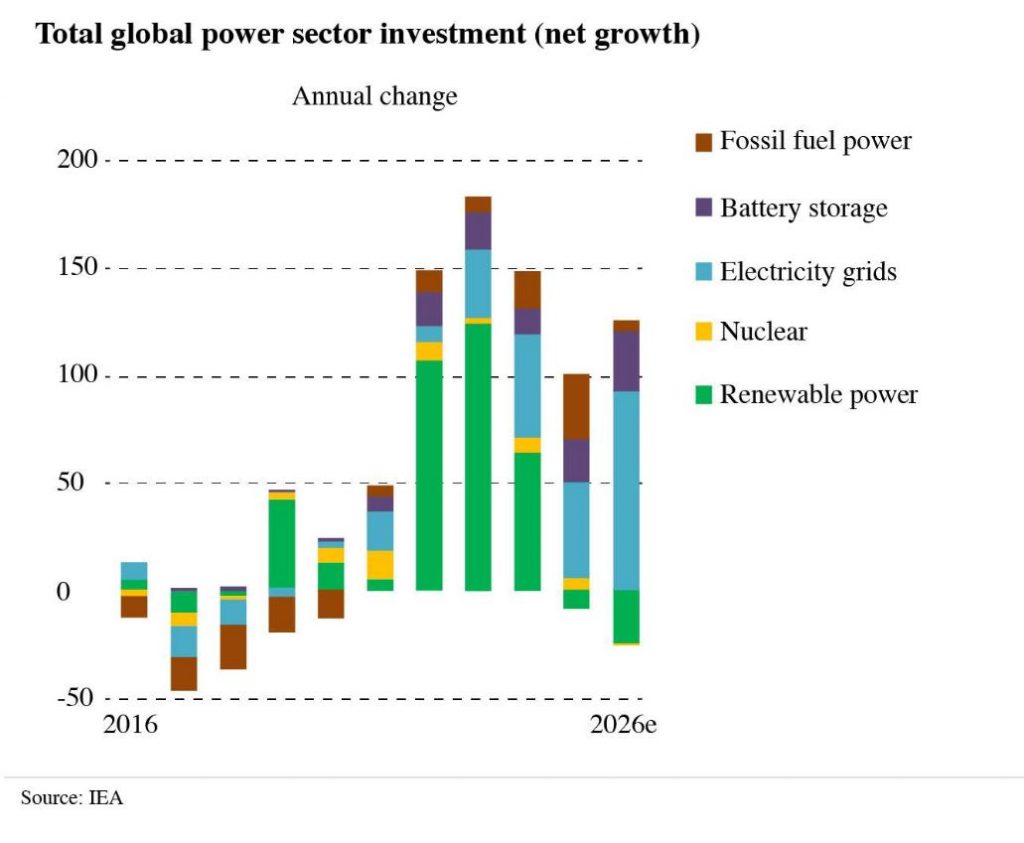
“Although strong short-term deployment is anticipated, capacity additions are still expected to fall short of the record-breaking 484GW of new solar and wind deployed in 2025. This is a key reason for the decline in global renewables investment expected in 2026, given the size of China’s domestic market,” the report concluded.
Pricing reforms last year are also expected to narrow profit margins and lower revenue certainty for renewable energy developers.
The short-term forecast for the US for new solar and wind deployment has also been downgraded due to the phase-out of tax credits and volatility surrounding Foreign Entity of
Concern rules and federal permitting procedures.
“Having plateaued from 2023 to 2025, low-emissions generation investment is consequently expected to decline in 2026,” the IEA said.
It pointed to US data for the second half of 2026 as a critical indicator to evaluate the resilience of solar and wind projects, given the heightened risks and removal of fiscal support.
A nuclear investment resurgence has also continued, exceeding $US80bn annually, with nearly 80 gigawatts of new nuclear capacity under construction across 15 countries.
A global pivot to net zero emissions may have also cooled in terms of momentum with the IEA noting the proliferation of sustainable finance and sustainability disclosure regulations had slowed.
“Asset managers, particularly in the United States, have distanced themselves from net-zero and sustainable finance initiatives, partly due to legal concerns about co-ordinated climate commitments,” the IEA said.
Carbon capture and storage, the technology relied up on by many oil and gas producers to lower emissions, also has an uncertain outlook with investment in 2026 revised down due to delays and “schedule revisions” by project developers.
“Compared with last year’s assessment, project timelines have been pushed back, shifting a
growing share of announced capacity into the mid‑2030s, and capital costs have risen above earlier expectations.”