
Originally published by Matthew Benns of The Daily Telegraph
22.08.2026
Special Report: Pristine tracts of regional Australia have become the “new wild west” where “cowboy operators” are racing each other to stake a claim and cash in on Labor’s government funded renewables bonanza.
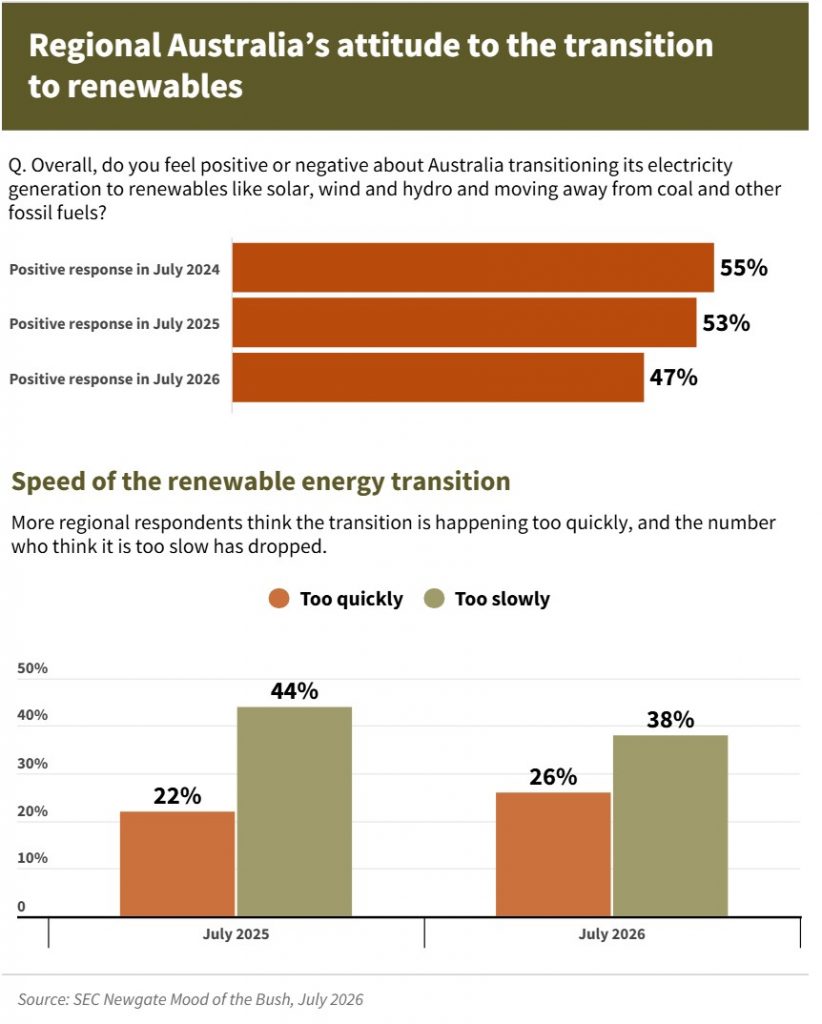
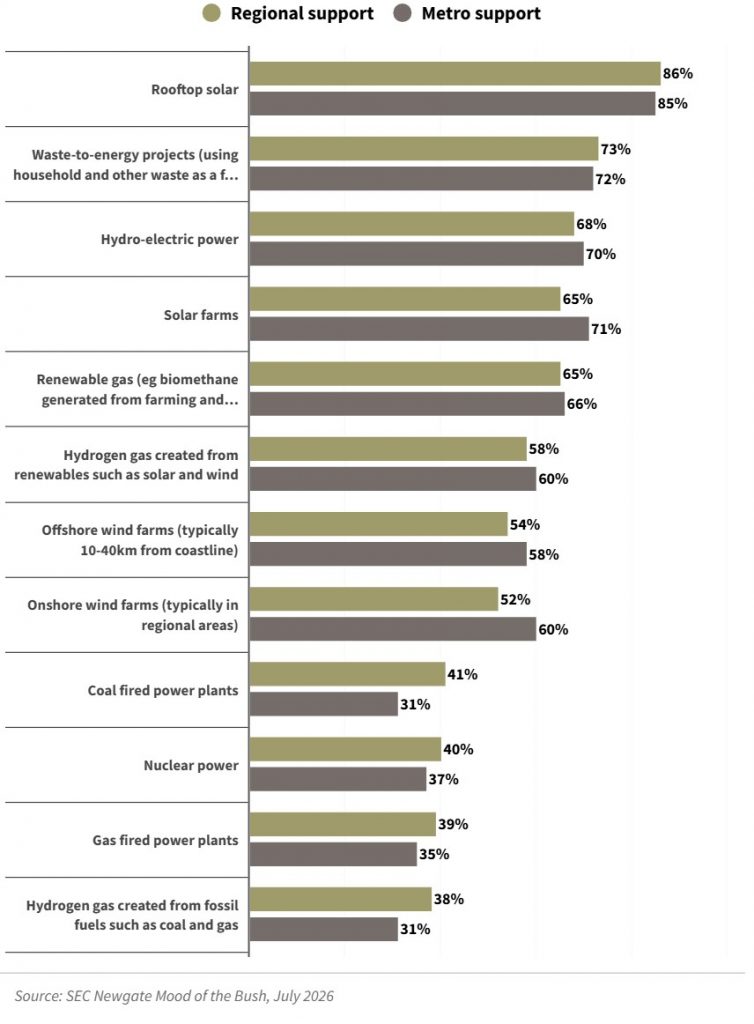
It comes as a new SEC Newgate survey found just over a quarter of people in regional Australia believe the speed of the renewable energy transition is moving too quickly.
Almost three quarters of the renewable companies putting Chinese made wind turbines and solar panels across the bush are foreign owned. Deceitful behaviour by the rapacious companies has turned neighbours against each other and killed villages.
Third generation Binalong farmer and mother of three Emma Webb said the Bendenine wind project surrounding her farm in the Yass Valley had become a real time case study of how the renewable energy rollout is failing regional communities across Australia.
“Unusually we are a community united not divided because the majority of the 90 proposed wind turbines are on just two properties and the rest of our community is united in opposition,” she said.
Like communities across the country Mrs Webb has joined with her neighbours to fight the foreign invasion of their land and discovered Energy Minister Chris Bowen’s much vaunted safeguards favour the developers and are aimed at ensuring the renewable rollout goes ahead.
She knows what is coming because the neighbouring suburb of Rye Park has already been through it. Federal Labor Alison Byrnes MP recently visited the village outside Yass to boast how one of the state’s biggest wind farms was creating “more jobs, cheaper power and a cleaner future”.
But the only job the 66 wind turbines have created in Rye Park is for the person who takes her cadaver dogs out every fortnight to collect the carcasses of dead birds killed by the giant rotating blades. Twenty wedge tailed eagles in the first 18 months of operation.
Former Rye Park Progress Association president David Sainsbury said the deceitful behaviour by the rapacious company behind the wind farm had turned neighbours and lifelong friends against each other and killed the village, people moved away, the school closed and the new $1 million footpath built by the developer to service became redundant.
“Friends who would look out for each and help fight bushfires together no longer speak,” he said, breaking down in tears. Mr Sainsbury claimed the company had been deceitful, signing up people to host turbines and then silencing them with non disclosure agreements long before the project was announced.
“The atmosphere became so bad I had a complete mental collapse. The police came and took my guns. My wife and I had to move away.”
When the representative from Wind Prospect came to call Mrs Webb invited them in. “You make them coffee and they sit in your kitchen and tell you how they are about to ruin your life,” she said. They explained her neighbour had signed up to host wind turbines as tall as the Crown Tower at Barangaroo in Sydney right up to her boundary and that she could do nothing about it.
“They broke my heart. When they left I burst into tears.”
Mrs Webb and her neighbours are the latest victim in what Yass Valley mayor Jasmin Jones calls “the new wild west”, where cowboy operators are racing each other to stake a claim and cash in on Labor’s government funded renewables bonanza.
“If what they were doing was above board they would hold open town hall meetings and discuss what is happening,” she said. Instead they signed wind tower hosts up in secret before the project was announced. “They know what they are doing is wrong which is why they hide until it is too late.”
Mrs Webb, now the president of the Binalong Bowning Community Action Group, said: “We found that Wind Prospect’s parent company in the United Kingdom went into administration,” she said. In papers filed in the UK, Wind Prospect outlined a deliberate strategy to raise $40 million from its projects in Australia to pay creditors. Two of those wind farms in Victoria have now been underwritten by the Australian taxpayer cash under the Capacity Investment Scheme.
“We actually managed to get a meeting with Chris Bowen who told us to contact the Clean Energy Council with our concerns,” Ms Webb said. “They told us the developer was operating within the rules.
However the Clean Energy Council’s Best Practice Charter is a voluntary set of principles drafted by its board which is made up of renewable energy company bosses.
“They are effectively marking their own homework,” Mrs Webb said. “What chance do we have to expose their behaviour when the Council set up to police them is stacked with the bosses of all the renewable companies?”
A Clean Energy Council spokesman said its industry standards “sit alongside government regulation” but do not replace it.
“Securing land has to come before formal consultation because you cannot consult a community about a project if you don’t know where you’re going to build it,” he said.
A spokeswoman for Minister Bowen said Australian farmers and regional communities “deserve straight answers and high standards” and that those who engage with the Developer Rating Scheme run by Equifax will be recognised.
“We expect Equifax to deliver this system in line with the Government’s policy goals and will be holding them to the high standard we hold all government contracts to,” she said.
However Mrs Webb said the ratings scheme was voluntary and it was unclear if Wind Prospect had even signed up because the register was not yet up and running.
Binalong is outside NSW’s closely regulated Renewable Energy Zones and so the community has no say until it comes before Planning Minister Paul Scully. That might not be for years.
Mr Scully said renewable energy companies should “undertake meaningful, early and ongoing engagement” with communities.
“Following concerns raised by the community, the Planning Secretary and representatives from my office recently met with several wind farm proponents and were direct: they are expected to undertake proper and meaningful engagement and to work with the community, not just tick a box,” he said.
Mrs Webb said that was too late. “The damage to our community is being done right now and we have absolutely no right of reply or protection. It is a living nightmare.”
A Wind Prospect spokesman said its development approach was “consistent with standard practice” for wind energy development.
“Discussions with potential host landowners are private rather than secret,” he said.” Once there is a potentially viable project, Wind Prospect engages with neighbours, community representatives and other stakeholders.”
He said there was no suggestion Australian taxpayer cash would be used to bail out the company’s creditors in the UK.
This article is part of the Bush Summit series supported by Hancock Prospecting, Woolworths, Ampol, AAMI, Toyota, Powerhouse Museum, Clubs NSW, Qantas, The South Australian Government, Northern Territory Government, Invasive Species Council, Cruise Lines International Association, Greyhounds NSW, Charles Sturt University and Dubbo Regional Council.


Special Report: Pristine tracts of regional Australia have become the “new wild west” where “cowboy operators” are racing each other to stake a claim and cash in on Labor’s government funded renewables bonanza.
It comes as a new SEC Newgate survey found just over a quarter of people in regional Australia believe the speed of the renewable energy transition is moving too quickly.
Almost three quarters of the renewable companies putting Chinese made wind turbines and solar panels across the bush are foreign owned. Deceitful behaviour by the rapacious companies has turned neighbours against each other and killed villages.
Third generation Binalong farmer and mother of three Emma Webb said the Bendenine wind project surrounding her farm in the Yass Valley had become a real time case study of how the renewable energy rollout is failing regional communities across Australia.