Originally published by Karma Barndon of Australia’s Mining Monthly
08.03.2026
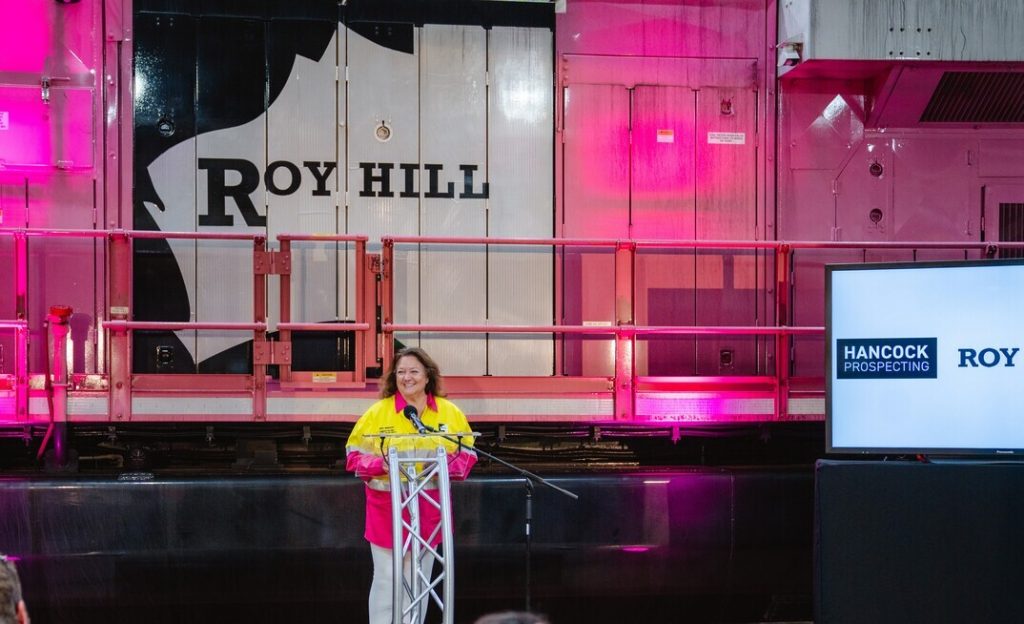
Western Australia mining magnate Gina Rinehart says she was written off more times than she wanted to remember while trying to get the US$10 billion Roy Hill project off the ground, initially with a very small company in a very male-dominated environment.
Speaking with Australia’s Mining Monthly for International Women’s Day 2026, Rinehart said it was only through persistence, hard work, long hours, risk and some very loyal supporters such as Tad Watroba, Hancock Prospecting transformed, from a struggling small company with assets either heavily mortgaged or under legal claim or threat, into the successful mining and agricultural business it is today.
She said attitudes had changed for the better in the mining industry over her time and the competitiveness had died down somewhat.
“For a while I regretted involving my mother’s name for Hope Downs, [when] a competitor changed this to ‘Hopeless Downs’ [and] we found out from a very large steel mill the competitor was hugely exaggerating the underground water all Pilbara projects have,” Rinehart said.
“That turned into a fast-flowing major water problem for the Hope Downs project, undermined our proposed mine and made it difficult to get steel mills to back us with ore offtake contracts.”
Rinehart said unfortunately for Australia, the one thing that had not improved was the federal government not appreciating mining.
“Without this industry, the government’s record debt will increase, more businesses will be added to our record business failures and the standard of living of Australians will fall,” she warned.
“I think people in WA largely understand the contribution of the mining industry but those over east, especially in Canberra and some major cities have long taken it for granted and seem to think it doesn’t matter what environmental and other burdens are dumped on it, somehow the benefits will continue to flow.”
Rinehart said mining helped pay for Australia’s welfare, pensions, climate change expenditure, hospitals and “declining education”, while having to deal with policies and red tape that made the industry less productive.
“And, if a company somehow can struggle through such tape, then it’s got the problem of the added cost of the green incinerator, the toxic solar panels and toxic, bird and bat killing and horribly maiming wind towers and expensive batteries, which only store energy for a few hours,” she said.
“Canberra does not want to understand that the unreliability of electricity and high-cost electricity, hurts or prevents industry.”
Rinehart said fellow miner Lynas was unable to meet its production schedule because of unreliable electricity, which in turn reduced its revenue and the tax revenue it would otherwise have provided.
The inspiration
Rinehart credits her father, Lang Hancock, for her aspirations.
“My father is recognised for discovering iron ore in the Pilbara in November 1952 during his famous flight of discovery, and for spending more than eight years of his life endeavouring to persuade the Australian and then longer for the state government, to lift their respective bans on export and tenements, which had stymied the iron ore industry,” she said.
“His find and persistence led to the lifting of the export embargo in 1960 and changed the course of history for WA and Australia.”
Hancock was the first to “discover” iron ore in the Pilbara while flying a small aircraft over the Hamersley Range, above the Turner River and Boolgeeda Creek.
He lobbied for the longstanding embargo on the export of iron ore to be lifted and then worked to attract national and international interest to develop the Pilbara’s mining industry.
Unfortunately, Hancock’s dream of owning an iron ore mine never came to pass.
However, Rinehart said more than 10 major iron ore mines had been developed from her father’s original discoveries.
“His incredibly keen interest in bringing the benefits of development to the remote north consumed decades of my father’s life and rubbed off on his small family,” she said.
“His persistence and dedication was inspiring [and] in his lifetime I could certainly see benefits brought to our northwest, such as more airports, roads, shops, air conditioning, fresh food deliveries and ice cream.”
Rinehart said her father truly believed developing the iron ore mining industry in the Pilbara would lift the standards and make Australia a stronger country.
“As dad often said, Australia could become one of the greatest countries in the world, if it was able to develop its mining industry, how could this not be inspiring,” she asked.
Biggest achievement
Rinehart said the $10 billion mega iron ore operation at Roy Hill was the star in the Hancock crown.
She said Roy Hill achieved the fastest construction start-up of any major greenfields resource project in northern Australia and been awarded and recognised for leading the industry in innovation and technology.
“Roy Hill didn’t happen overnight [and] there were times we were totally stymied,” she said.
“Were there a few sleepless nights? Yes more than a few.”
Rinehart said the obstacles and hurdles put in the way included thousands of government approvals and permits and the government taking away Roy Hill’s proposed port and rail access, which could have stranded the project and destroy the then considerable investment.
“But every staff member can be proud of what we have achieved,” she said.
“It’s one thing to be the most successful private company in Australia’s history, but when staff tell you Hancock is the best mining company to work for, that lets us know we are doing this well.”
In the pink
Rinehart admitted she was most proud of the fact that the company had initiated another world-first with pink trucks, pink locomotives, pink trains, pink wet high-intensity magnetic separation plants and pink personal protective equipment, all celebrating women in mining and highlighting her unwavering support for those suffering from breast cancer and its related cancers.
“This culture has spread throughout our company and Hancock staff often tell me of their appreciation for the care, consideration and support extended by other staff members when they are faced with the fear and battle of breast cancer,” she said.
“Among the achievements I’m most proud of has been my drive to employ many of our wonderful veterans, who have sacrificed so much for our country.
“I’m proud to say that we are giving many veterans access to the highest paying jobs in the country after their service to our nation, plus access to our company benefits.”